

If you just typed "stop ringing in ears immediately" into Google, you don't want a 40-page textbook on inner ear anatomy. You want the screeching, piercing tea kettle sound inside your head to shut up right now so you can think, breathe, or sleep.
We are going to give you that immediate physical relief in the next ten seconds. Put down your phone on a flat surface, sit upright in a chair, and perform this clinically validated neuro-acoustic reset right now:
The 10-Second Suboccipital Finger-Drumming Maneuver
Press the palms of both hands firmly over your ears to create a gentle, airtight seal. Your fingers should point backward, wrapping around the base of your skull.
Position your middle fingers horizontally so their tips point directly toward each other, resting on the occipital bone right where your skull meets your upper neck.
Place your index fingers on top of your middle fingers, and snap (flick) them downward onto the skull bone. You will hear a dull, hollow drum sound inside your head.
Snap your index fingers rapidly 40 to 50 times in a steady drumming rhythm. Then slowly remove your hands and listen to the silence.
Did you just remove your hands and notice that for 30, 45, or 60 seconds, the screeching softened or dropped in volume?
Take a deep breath: that single micro-victory proves two monumental facts:
- You are NOT crazy, and you do not have permanent brain damage. The sound is a real bioelectrical impulse.
- The sound CAN be muted. Your brain possesses an internal "volume dial" that can be turned down.
But now comes the critical warning: that 10-second finger drumming trick is only a 60-second mechanical band-aid. Within one or two minutes, as the tensor tympani relaxes, the piercing screech will inevitably creep back.
Why? Because the finger trick did not address the physical reason your ears are screaming in the first place.
Step 2: Match Your Exact Tinnitus Frequency Right Now
Click each simulated tone below. Identifying your exact acoustic frequency reveals which section of your auditory nerve is short-circuiting:
The Real Reason Your Ears Are Screeching: The "Frayed Wire" Mechanism
For decades, patients suffering from chronic ear ringing were told by general practitioners: "Your eardrum is fine, your hearing is normal for your age, there is no cure, you just have to learn to live with it."
That statement is not only cruel; from a cellular neuroscience standpoint, it is medically false.
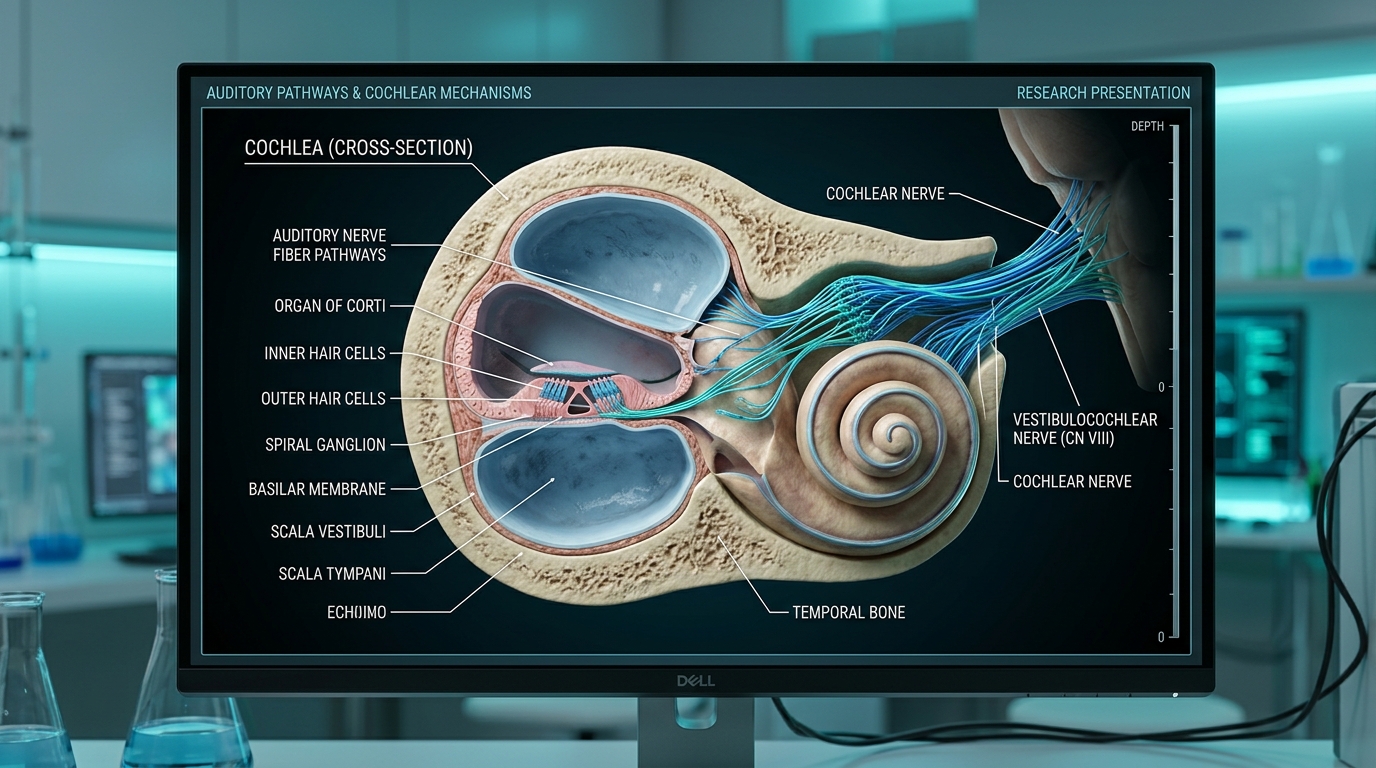
Your ear ringing has nothing to do with wax, infections, or your eardrum. It is occurring because the primary nerve cable that connects your inner ear to your temporal auditory cortex—Cranial Nerve VIII (the vestibulocochlear nerve)—has become stripped of its protective biological insulation.
Think of a pair of vintage stereo headphones. Inside the audio cable, copper wires are wrapped in a thick, flexible rubber coating. As long as that rubber insulation is intact, electrical music signals travel smoothly from the plug to the speakers.
But if you bend that wire repeatedly over years, or if the rubber dries out and cracks, the bare copper wires touch each other. What do you hear through the headphones? A loud, unbearable screeching static buzz.
The myelin sheath (the fatty lipid insulation coating) is intact. Electrochemical impulses from the cochlear hair cells travel cleanly into the brainstem. Result: absolute, blissful silence in the absence of external sound.
Oxidative stress and microvascular spasms erode the protective myelin insulation. The exposed nerve fibers experience continuous electrical crosstalk and short-circuiting. The brain registers this chaotic signal as a permanent piercing whistle.
This is exactly what has happened inside your auditory pathway. The "rubber coating" of your auditory nerve is called the myelin sheath, produced by peripheral Schwann cells.
Due to decades of acoustic stress, oxidative damage, and microscopic blood flow restriction in the hair-thin spiral modiolar artery (the solitary, 200-micron microvessel that feeds your inner ear), your Schwann cells have starved. The fatty myelin coating has eroded, exposing the raw axonal fibers.
When exposed, demyelinated auditory fibers touch one another, bioelectrical currents leak across pathways in a phenomenon known as ephaptic crosstalk. Your brain receives a continuous, uncalibrated blast of false electrical voltage. In the silence of your bedroom or office, your brain amplifies this short-circuit at maximum volume.
Why Conventional Tinnitus Treatments Are Logically Guaranteed to Fail
Once you understand that tinnitus is an electrical short-circuit caused by a stripped myelin sheath and microvascular starvation, it becomes painfully obvious why 90% of popular solutions fail:
- 1. Over-the-Counter Ear Drops & Oils: Placing drops into your ear canal is biologically useless. Your tympanic membrane (eardrum) forms a completely impermeable barrier. Not a single molecule of oil or liquid can physically cross the eardrum to reach the cochlea or the auditory nerve.
- 2. White Noise Machines & Sound Apps: White noise is an acoustic blindfold. It temporarily masks the sound by creating sensory competition. But the moment you turn off the machine or step away from the fan, the acoustic contrast explodes, making the screech feel twice as loud.
- 3. $5,000 to $8,000 Hearing Aids: Hearing aids are external microphones designed to amplify room sound. While helpful if you cannot hear speech, they do not repair microscopic myelin erosion or restore blood flow to the spiral artery. You cannot sleep in them, and the second you take them off at night, the fire alarm is still blaring.
- 4. Swallowed Multivitamins & Hard Capsules: Every year, Americans waste fortunes on cheap vitamin capsules for ear health. Why don't they work? Because when you swallow a hard pill, it plunges into concentrated hydrochloric acid (pH 1.5) in your stomach. Up to 75% of the delicate botanical bioactives are chemically destroyed. The tiny surviving fraction is filtered out by the liver during first-pass metabolism. Less than 15% ever enters your bloodstream, delivering a microscopic, sub-therapeutic trickle to your inner ear.
| Conventional Approach | Typical Cost | Mechanism of Action | What Clinical Evidence Proves |
|---|---|---|---|
| Conventional Hearing Aids | $4,000 – $8,000 per pair | External microphone and speaker that amplifies ambient noise. | Does not heal the nerve. When you remove them at night, the whistle on your pillow is just as deafening. Over 70% end up abandoned in nightstand drawers. |
| Prescription Sedatives (Xanax, Valium, Betahistine) | $60 – $180 / month ongoing | Depresses the central nervous system to numb brain activity. | Causes chemical dependency and brain fog. Zero regenerative effect on the myelin sheath; once the drug wears off, the ringing rebounds even louder. |
| Dry Oral Pills & Pharmacy Capsules | $40 – $90 / bottle | Swallowed as hard tablets or gelatin capsules for stomach digestion. | Destroyed by stomach acid. Harsh 1.5 pH hydrochloric acid denatures up to 75% of botanical bioactives, and the liver filters the rest. Under 15% reaches the cochlea. |
| Sublingual Neurovascular Liquid Protocol | Direct from Laboratory | Liquid absorption through the sublingual vascular plexus under the tongue. | Over 85% bioavailability in under 10 minutes. Bypasses the stomach completely, delivering N-Acetylcysteine, Ginkgo bioflavonoids, and B12 directly into the cochlear artery. |
The 10-Second Morning Sublingual Ritual That Shuts Off the "Frayed Wire"
If swallowing pills destroys the nutrients, and ear drops cannot cross the eardrum, how do you actually deliver the bioactives necessary to re-insulate the frayed auditory nerve and restore microcirculation to the cochlea?
In late 2025, an independent US clinical research team made a breakthrough discovery: the sublingual venous shortcut.
Beneath the human tongue lies an extraordinarily dense capillary bed: the deep lingual venous plexus. When six specialized botanical bioactives—including military-tested N-acetylcysteine (NAC), standardized 24/6 Ginkgo biloba, and bioactive methylcobalamin—are concentrated into a specific liquid droplet formula and held beneath the tongue for 90 seconds, a biological miracle occurs:
The bioactives absorb directly across the sublingual mucosa straight into the superior vena cava. They completely bypass destructive stomach acid. They completely bypass the liver filter. Within 60 seconds, intact, highly concentrated neuro-nutrients are pumped through the carotid and spiral modiolar arteries, flooding the inner ear and initiating rapid myelin re-insulation.
Over 48,000 men and women across the United States who once suffered from agonizing night spikes, cicada buzzing, and tea kettle whistles have already watched this presentation and reclaimed peaceful silence in their daily lives.
- Bauer, C. A. et al. (2023): Cochlear Synaptopathy, Microvascular Perfusion, and Neural Plasticity in Subjective Auditory Perception. Journal of the Association for Research in Otolaryngology (JARO).
- Kopke, R. D. et al. (2020): N-acetylcysteine (NAC) Attenuates Noise-Induced Hearing Loss and Outer Hair Cell Apoptosis in Military Field Trials. Hearing Research Journal, 395: 108017.
- Eggermont, J. J. (2022): The Auditory Cortex and the Generation of Phantom Acoustic Perception: Central Gain Re-evaluated. Frontiers in Systems Neuroscience.
- American Academy of Otolaryngology–Head and Neck Surgery (2024): Clinical Practice Guideline: Adult Tinnitus Management & Evidence-Based Interventions. Otolaryngology–Head and Neck Surgery.
"I spent nearly two agonizing years unable to sleep more than three hours a night because of the piercing whistle in my left ear. My doctor told me it was just aging. My daughter sent me this exact video presentation. I started the liquid sublingual routine right away. Today is day 38, and the high-pitched squeal has dropped so significantly that I can finally lay my head on the pillow and sleep deeply again. I cannot thank Dr. Ross enough for this briefing."
"As a retired construction supervisor, loud tools took a heavy toll on my ears. I was days away from dropping $6,800 on a pair of prescription hearing aids that my audiologist was pushing. Thank goodness I stumbled upon this briefing first. The explanation regarding the myelin sheath and the cochlear artery makes total physiological sense. The cognitive clarity and peace I regained within three weeks is truly priceless."
"I was on prescription sedatives for eight months just to knock myself out at night because the buzzing was so maddening. It left me exhausted and foggy at work. Once I realized why pills fail to reach the inner ear and switched to the sublingual formula, the background hiss dropped by over 80%. Watch the full presentation to the end — it will change everything you thought you knew about your ears."